
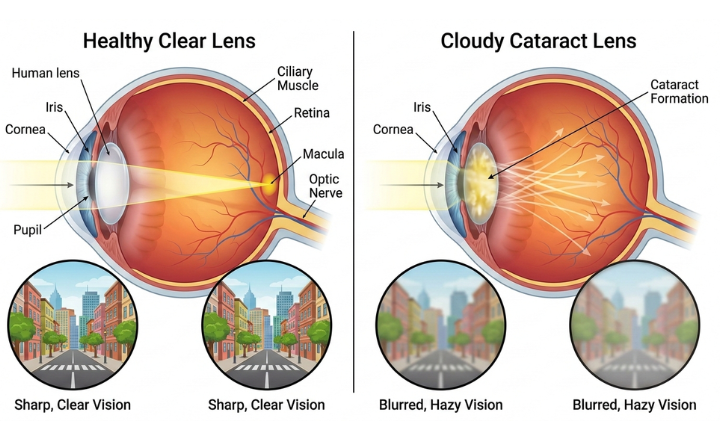
Cataract
A cataract is a condition where the natural lens of the eye becomes cloudy, causing blurred or hazy vision. Normally, the lens is clear and helps focus light on the retina for sharp vision. With age or certain health conditions, the proteins inside the lens clump together, making it less transparent. This leads to problems such as glare at night, difficulty reading small print, or colors appearing faded. Cataracts are one of the most common causes of reversible blindness worldwide.
1. What are the main causes and risk factors?
- ● Aging: The most common cause.
- ● Diabetes: High sugar damages lens proteins.
- ● Eye injury or trauma
- ● Prolonged steroid use
- ● Excessive sunlight (UV exposure)
- ● Smoking and alcohol use
2. What are the symptoms of cataract?
- ● Blurred or foggy vision
- ● Difficulty reading or driving at night
- ● Sensitivity to bright light or glare
- ● Seeing halos around lights
- ● Frequent changes in glass power
- ● Faded or yellowed colors
3. How is cataract diagnosed?
A simple eye examination with slit-lamp microscopy or retinal evaluation can easily confirm cataract. At Netram Eye Hospital, Nagpur, advanced diagnostic machines like Zeiss Humphrey Field Analyzer and Non-Mydriatic Wide-Angle Fundus Camera are used to assess lens clarity and retinal health.
4. What is the best treatment for cataract?
The only effective cure for cataract is surgery. The cloudy lens is replaced with an artificial intraocular lens (IOL). At Netram Eye Hospital, we perform Advanced Stitchless Microincision Cataract Surgery — a painless, no-injection, no-stitch, no-bandage procedure done with Swiss-made Oertli Phacoemulsification System.
Patients can choose from Premium IOLs such as Trifocal, EDOF (Extended Depth of Focus), or Multifocal lenses, which give clear vision for distance, intermediate, and near without glasses. Dr. Ashutosh Jaiswal, a gold medalist and internationally trained super-specialist from Sankara Nethralaya (Chennai) and L.V. Prasad Eye Institute (Hyderabad), personally performs all surgeries ensuring world-class outcomes.
5. What is recovery like after cataract surgery?
Patients usually notice clear vision within 24–48 hours. Eye drops are used for 3–4 weeks. Normal activities can be resumed within 2–3 days. Avoid touching or rubbing the eye and follow doctor’s advice carefully.
6. How to prevent or delay cataract?
- ● Control diabetes and blood pressure
- ● Wear UV-protective sunglasses
- ● Eat foods rich in vitamin A & antioxidants
- ● Quit smoking and alcohol
- ● Get regular eye checkups after age 40
Visit the Experts
Netram Eye Hospital, Nagpur
Address:
G6-10, Sai Krupa Apartment, Next to Chaudhari Hospital, Umred Road, Sakkardara, Nagpur – 440024
Phone:
+91 9859 804 804 / +91 9852 804 804
Website:
www.netramhospital.com