
Refractive Errors
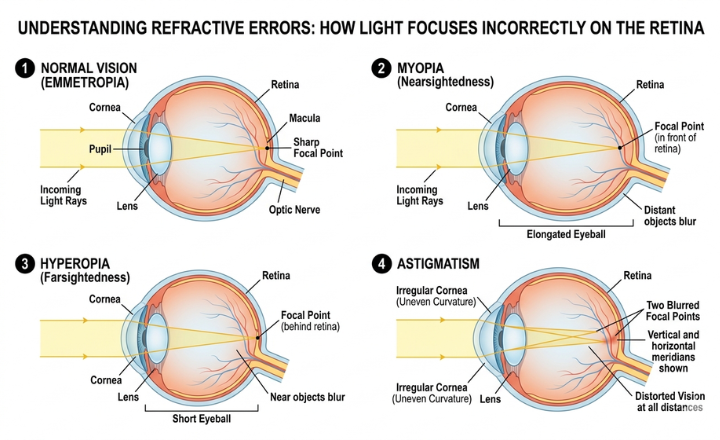
Refractive errors occur when the eye cannot focus light correctly on the retina, resulting in blurry vision.
1. What are refractive errors?
Refractive errors occur when the eye cannot focus light correctly on the retina, resulting in blurry vision. The most common types include:
- ● Myopia (Nearsightedness): Difficulty seeing distant objects clearly.
- ● Hypermetropia (Farsightedness): Difficulty seeing close objects clearly.
- ● Astigmatism: Distorted or blurred vision at all distances due to an irregular cornea or lens.
- ● Presbyopia: Age-related difficulty focusing on near objects, usually after age 40.
- ● Excessive sunlight (UV exposure)
Refractive errors are extremely common, affecting millions worldwide. If untreated, they can lead to eye strain, headaches, and difficulty performing daily activities. Modern treatments can restore clear vision without affecting the eye’s health.
2. What causes refractive errors?
Refractive errors are caused by a mismatch between the shape of the eye and the focusing power of the cornea and lens. Other contributing factors include:
- ● Genetics (family history of vision problems)
- ● Excessive screen time or near work
- ● Age-related changes in the lens (presbyopia)
- ● Eye injury or surgery in some cases
Early detection through regular eye exams can prevent worsening vision and allow timely correction.
3. What are the symptoms of refractive errors?
- ● Blurry vision at near or distance
- ● Squinting to see clearly
- ● Frequent headaches or eye strain
- ● Difficulty reading or seeing road signs
- ● Fatigue after long periods of visual tasks
These symptoms may vary depending on the type and severity of the refractive error.
4. How are refractive errors diagnosed?
An eye specialist performs a comprehensive refraction test to measure how light focuses on the retina. This may include:
- ● Visual acuity test (reading letters on a chart)
- ● Autorefractor evaluation
- ● Retinoscopy to determine prescription
- ● Corneal mapping or topography in some cases
Netram Eye Hospital, Nagpur uses advanced equipment to provide accurate prescriptions for glasses, contact lenses, or pre-surgical assessments for LASIK or Contoura Vision correction.
5. How are refractive errors treated?
Treatment depends on the type and severity:
- ● Glasses: Most common solution for all types.
- ● Contact lenses: For lifestyle convenience or sports.
- ● Refractive surgery (LASIK, Contoura, PRK): Permanently reshapes the cornea to reduce dependency on glasses or lenses.
- ● Presbyopia: Age-related difficulty focusing on near objects, usually after age 40.
- ● Excessive sunlight (UV exposure)
At Netram Eye Hospital, Dr. Ashutosh Jaiswal personally performs LASIK & Contoura Vision correction surgeries, using advanced technology for safe and precise results.
6. Can refractive errors be prevented?
While some refractive errors are genetic and unavoidable, lifestyle habits help reduce progression:
- ● Take regular screen breaks (20-20-20 rule)
- ● Maintain proper lighting while reading
- ● Eat a balanced diet rich in vitamins A, C, and E
- ● Get routine eye exams
- ● Protect eyes from UV sunlight
Visit the Experts
Netram Eye Hospital, Nagpur
Address:
G6-10, Sai Krupa Apartment, Next to Chaudhari Hospital, Umred Road, Sakkardara, Nagpur – 440024
Phone:
+91 9859 804 804 / +91 9852 804 804
Website:
www.netramhospital.com