
Retinal Disorders
The retina is the thin layer of tissue at the back of the eye that senses light and sends signals to the brain for vision.
1. What are retinal disorders?
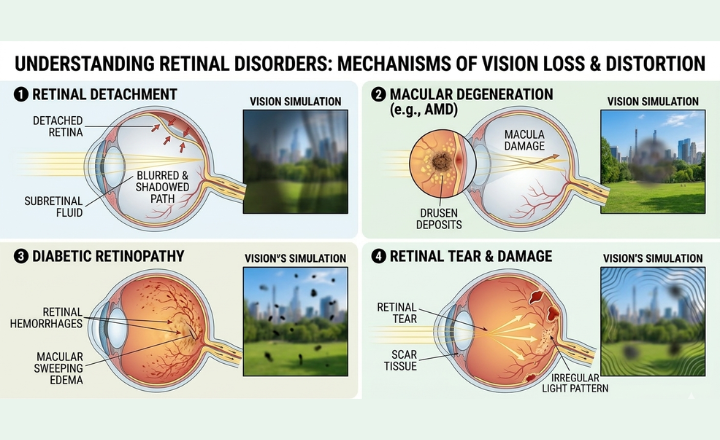
The retina is the thin layer of tissue at the back of the eye that senses light and sends signals to the brain for vision. Retinal disorders refer to any condition that affects the retina, leading to vision problems or even permanent vision loss if untreated. Common retinal disorders include diabetic retinopathy, retinal detachment, macular degeneration, and retinal vein/artery occlusion.
2. What causes retinal disorders?
- ● Diabetes: High blood sugar damages retinal blood vessels (diabetic retinopathy)
- ● High blood pressure: Can cause bleeding or vessel blockage in the retina
- ● Aging: Macular degeneration is common in people over 50
- ● Eye trauma: Can cause retinal tears or detachment
- ● Genetic factors: Inherited retinal disorders like retinitis pigmentosa
- ● Blood clot or vascular issues: Retinal vein or artery occlusion
Early detection is crucial as some retinal disorders may progress without noticeable symptoms until significant vision loss occurs.
3. What are the symptoms of retinal disorders?
- ● Sudden or gradual loss of vision
- ● Floaters (spots) or flashes of light
- ● Blurred or distorted vision
- ● Shadows or curtains across vision (in retinal detachment)
- ● Difficulty reading or recognizing faces (in macular disorders)
- ● Dark or empty areas in vision
If any sudden vision changes occur, emergency evaluation is necessary to prevent permanent loss.
4. How are retinal disorders diagnosed?
- ● Comprehensive eye examination to check vision and retina
- ● Fundus photography and OCT (Optical Coherence Tomography) for detailed retinal imaging
- ● Fluorescein angiography to examine blood vessels in diabetic or vascular conditions
- ● B-scan ultrasound for opaque media or suspected retinal detachment
Netram Eye Hospital, Nagpur uses advanced Non-Mydriatic Wide-Angle Fundus Camera and OCT machines to detect retinal disorders accurately, even in early stages.
5. How are retinal disorders treated?
- ● Laser therapy: For diabetic retinopathy and retinal tears
- ● Intravitreal injections: Anti-VEGF medications for macular degeneration or diabetic macular edema
- ● Vitrectomy surgery: For severe retinal detachment, hemorrhage, or complicated cases
- ● Control underlying conditions: Diabetes, blood pressure, and cholesterol management
Netram Eye Hospital combines cutting-edge technology and expert care by Dr. Ashutosh Jaiswal, offering retina surgeries, laser therapy, and intravitreal injections with precise and safe outcomes.
6. How can retinal disorders be prevented or managed?
- ● Annual eye checkups, especially for diabetics and hypertensive patients
- ● Maintain blood sugar and blood pressure within normal limits
- ● Avoid trauma and protect eyes in risky activities
- ● Timely treatment of eye infections and systemic conditions
Visit the Experts
Netram Eye Hospital, Nagpur
Address:
G6-10, Sai Krupa Apartment, Next to Chaudhari Hospital, Umred Road, Sakkardara, Nagpur – 440024
Phone:
+91 9859 804 804 / +91 9852 804 804
Website:
www.netramhospital.com